
In honor of the new season of Our Flag Means Death hitting this week, a show that in its own way is pretty Shakespearean, I thought it’d be fun to look briefly at a couple pirate-related appearances in Shakespeare’s plays.
In full transparency, I intended for this to be goofy and based entirely off whatever pirate memories exist in my head. But I did briefly search for pirate appearances in Shakespearean works and discovered that there is scholarly research on pirates in Shakespeare. Because of course there is!
Rather than turn a goofy little article in something well researched, I still went with this version. But, head’s up for the three people that see this: you can expect a future podcast on pirates in Shakespeare.
(Also, there are pirates in more Shakespeare plays than this! These are the tip of the piratical iceberg.)
A homoerotic pirate captain in Twelfth Night
My favorite of all the Antonios in Shakespeare’s plays (which is probably worth its own episode too), the Antonio in Twelfth Night also happens to be a pirate.
Some people might not classify him this way. He’s often listed as a “sea captain” or referred to as a sailor. But I’m counting him.
The man is a sea captain, he’s wildly in love with Sebastian, and if he’s caught mucking around in Illyria, he’ll be killed. And, in my opinion, if you are usually on a boat, you give major queer vibes, and someone is going to kill you if they find you on land, you are a pirate.
His character is interesting in that the language he uses to describe his feelings for Sebastian is strong and straightforward. You don’t really have to read into the homoeroticism. It’s just there.
For example, when Sebastian tries to strike out on his own, Antonio follows him. Sebastian says that he wasn’t trying to cause Antonio any trouble. Antonio replies:
I could not stay behind you. My desire,
More sharp than filèd steel, did spur me forth;
And not all love to see you, though so much
As might have drawn one to a longer voyage,
But jealousy what might befall your travel,
Being skill-less in these parts, which to a stranger,
Unguided and unfriended, often prove
Rough and unhospitable. (3.3 4-11)
Because of his homoerotic desire, Antonio unfortunately, doesn’t get coupled up at the end of the play. But I like to pretend that after the play’s events, Sebastian kind of carries on with him anyway, on the side.
A Pirate Kidnapping in Hamlet
There’s a great Tumblr post about Hamlet. Okay, there are a lot of great posts on social in general about Hamlet, but this one specifically deals with pirates:

While you probably were forced to read Hamlet (or at least part of it) at some point, did you remember that it had pirates in it?
The pirates themselves don’t appear on the stage. The audience learns about them in a letter Hamlet writes to Horatio. Claudius had shipped Hamlet and his friends, Rosencrantz and Guildenstern, off to England in the hopes that the English powers that be would execute Hamlet for him.
But on the way to England Hamlet’s ship gets raided by pirates, who kidnap Hamlet and then decide to carry him back to Denmark if he does them a favor in return. I don’t think we ever find out what that favor is and seeing as Hamlet dies just a few scenes later, I’m not convinced he actually manages to carry out his promise to do them a solid back.
In this case, the pirates are really more a plot device than anything else, but we’ll accept it.
A Pirate Kidnapping Prelude with Julius Caesar
There are no pirates in Julius Caesar, but a pirate kidnapping did happen in the real life of Julius Caesar himself and because we know that Shakespeare read Plutarch’s account of Caesar’s life, I’m guessing he knew about the pirate kidnapping incident.
When Julius Caesar was about twenty-five, he was kidnapped by Cicilian pirates. The kidnapping didn’t quite go as planned.
The pirates initially wanted to set a ransom for 20 talents but Caesar protested, saying he was worth more than that and they should increase the ransom to 50 talents (hilarious). He was prisoner of the pirates for thirty-eight days and during that time, according to Plutarch:
- “…he treated them so highhandedly that, whenever he wanted to sleep, he would send to them and tell them to stop talking.” (2.2)
- “…he joined in all their games and exercises, just as if he was their leader instead of their prisoner.” (2.3)
- “He also wrote poems and speeches which he read aloud to them, and if they failed to admire his work, he would call them to their faces illiterate savages, and would often laughingly threaten to have them all hanged.” (2.4)
Less hilariously, after the pirates let him go, Caesar had them all imprisoned and then later had them crucified for kidnapping him.
Whether this story is entirely true or not, it does show the legend Caesar built up for himself and why the conspirators would have been so concerned with making sure they kept their plans since they knew just how brutal Caesar’s retaliation could be.
Like I said, there are more pirate ties beyond these three examples and at some point we’ll really dig into it. But in the meantime, enjoy, regardless of your piratical affinities.
Now I bid thee farewell, ye scurvy curs!
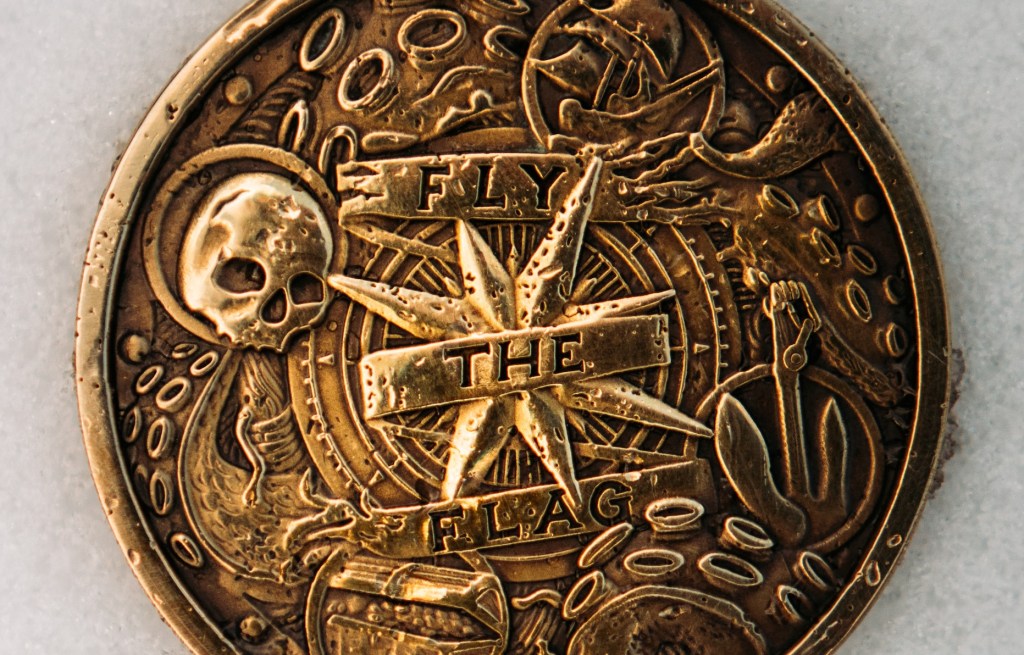
Credit for feature image of cool pirate coin: Jakob Rosen on Unsplash
 Something Shakespeare This Way Comes
Leave a comment